In these strange times, with long vacations and adventures to far off lands being reduced to crumpled pieces of paper that are forced to be cast aside and tossed into the “wishful thinking” basket, my wife and I have instead started taking little Covid mini-trips to places near our home in the Midwest. The trips are short, and not our “dream vacations”, but provide a much needed break and change of pace. My Covid-induced daily routine consists of waking up, walking to my desk in the living room, and working at my computer, often for hours. When the workday is done, I amble the short distance to my couch, to spend the few hours before bed listening to the news and looking for glimmers of change in the fight against Covid. Not a pretty sight, or very imaginative, and the repetition is an anvil on one’s psyche, at least mine.
These little out-of-the box trips, however, often planned by my wife only that Friday morning before filling the tank and driving off, have been a lifesaver. My wife is a saint.
Recently, we took a spur of the moment trip to Dubuque, Iowa. Now, living nearby, we had often driven through, around, near, and within the vicinity of, Dubuque many times in our Midwestern travels, but this was our first time actually to stay in and be in, Dubuque. What an interesting and quintessentially American little town. If you’re looking for a slice of American history pie, look no further. The making of this fascinating area of the country mirrors much of how America came to be, and acquired its very distinctive cultural vibrancy.
Dubuque is named for a French Canadian man in the late 18th century by the name of Julien Dubuque, whose write-up on his bronze statue outside of our hotel, described him as, and I quote, “a swarthy trapper”. Not sure what that is, but I am sure it is something, that I am not. I suspect many men these days would give their right eye for that moniker, and indeed, many men would be aptly described in that manner. However, I also suspect that in the cultural world of today those words are likely never to be uttered in real time again. I miss those days, when strong, capable, competent, adventurous men, and indeed women, could strike out into the wilderness and earn the right to be called by all, “a swarthy trapper.” Ah, but I digress.
Apparently, Dubuque came to the area after being charged with exploring the region by the then Spanish governor of the Louisiana Territory, which at that time included the upper Midwest and northern reaches of the Mississippi River, which the city of Dubuque abuts. This beautiful region became known as the Mines of Spain. In the exploration charter for Dubuque, identifying the area for Spain was required, and the region is rich in minerals and ore deposits, mostly lead, which the local Native Americans, the Mesquaqie, were already mining with gusto by the time of Western exploration.
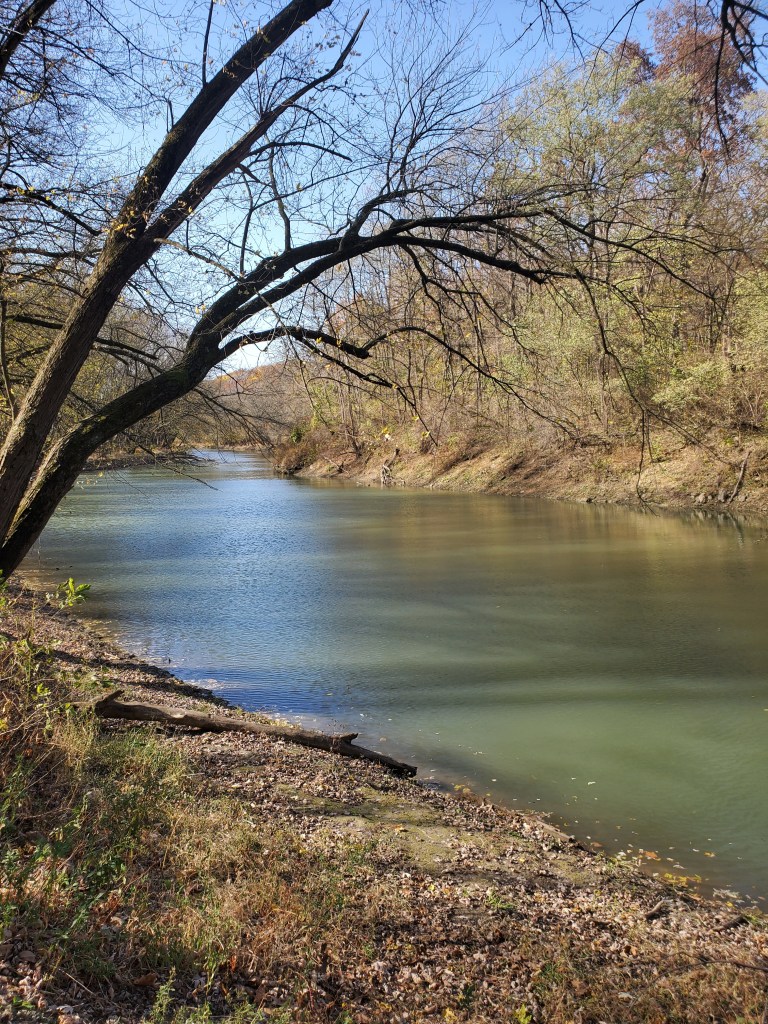
After surveying the area, and establishing trade and merchant relationships with the local Native Americans, Dubuque married the daughter of a local chief, and settled in for the long haul. Together, they continued the local practice of “pit mining”, which involved removing the ore from large pits for later smelting and refinement, for trade with other outposts. After he died, he was buried at the headwaters of Catfish Creek, a meandering and beautiful little river, that partitions the local hills and valleys, and ultimately empties into the mighty Mississippi.
After the pit mining in the area ceased, the region was converted to a protected land park, to conserve its natural beauty and provide minimal-impact outdoor recreation for later generations of Americans. One of the prime local hiking trails is a winding path through striking limestone bluffs and oak trees, to what is called the Pine Chapel. In this short trek, you see a true microcosm of the geological formations, bluffs, and nestling valleys. My wife and I took this trail, and it did not disappoint.
Nestled in the heart of the Mines of Spain, and starting in the EB Lyons Interpretive Center, the foot trail leads to the small chapel, which is an exact replica of a little chapel from Germany, built by Otto Junkermann, a German pharmacist who emigrated to the area before the Civil War. He and his family worked the land, planted vineyards, and carved an existence out of this beautiful, but difficult, environment. The Pine Chapel is the last surviving full structure built by the Junkermann family on their property, in the now-protected area.
Now to call the little building a “chapel” is a bit of a misnomer. No regular denominational services were held there, according to the informational plaque, and it was used more as a trading post, meeting house, and, during prohibition, a place to store grain and make whiskey. However, it was beautifully constructed, and now quietly sits alone on top of a rounded hill, overlooking the small valley. It was quite peaceful and serene to walk the last steps up the hill and be in its presence. Its isolation and beauty were very moving. One can’t help but think of what may have motivated this German immigrant to move halfway around the world, and make his run to improve his family’s lot, here in America. His humbly recreated chapel must have been a comfort to him and his family, and a small reminder of where they came from, and why they were here, in America.
It was a fascinating afternoon, to visit an area first settled, cultivated and developed by Native Americans, later more firmly expanded with the help of a French-Canadian on the authority of Spain, and finally ushered into the world of modern commerce by a German pharmacist looking for a new life in a new world. I don’t know about you, but I’m pretty sure there aren’t many countries that can boast of such opportunity, cultural diversity, history, natural beauty, and independence of spirit and ingenuity.
The last few years in America have been as divisive and angry as almost any other era. The Covid pandemic has further strained our temperament as a people. Everyone it seems, is questioning the authenticity and patriotism of folks who hold different views than they do.
If as a people we would remind ourselves of the quintessentially American cultural fabric and history found in little but fascinating places like Dubuque, a history that, I”m sure, mirrors the story of many other corners of America, neither Covid nor divisive politicians can ring the death-knell on our hopes and dreams just yet.
Let me reach down to that basket again. I think I can just reach that crumpled piece of paper. Yep, there, I got it. Exciting things are waiting in our future.
copyright 2020 – all rights reserved – by D. James Clark
 D. James Clark